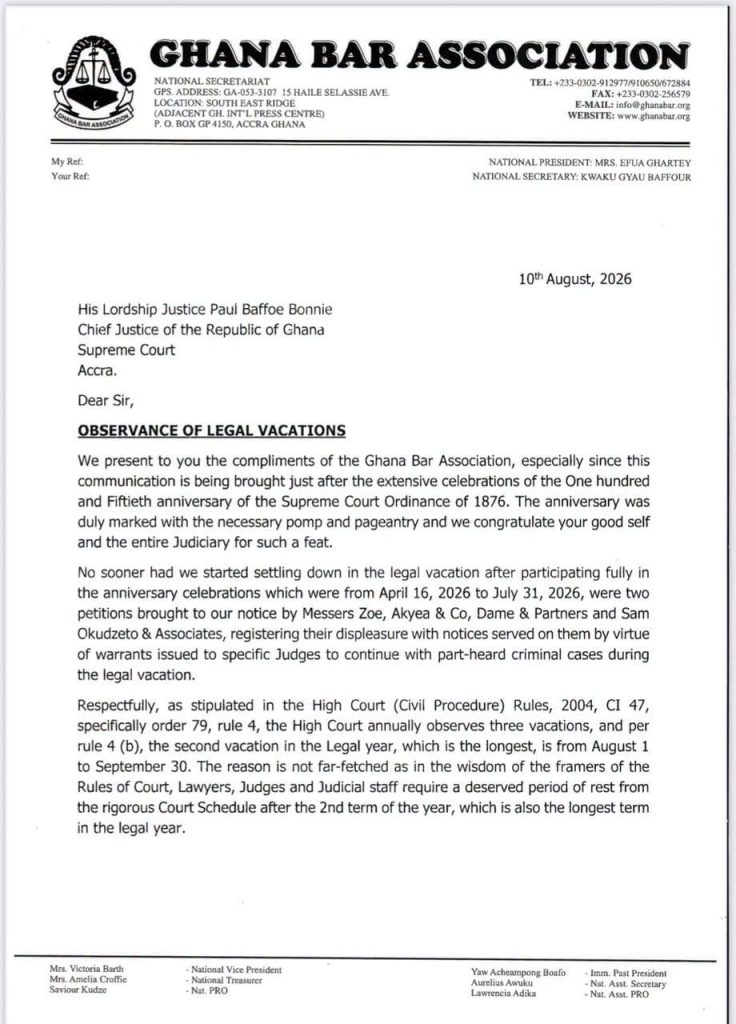

The Ghana Bar Association (GBA) has officially petitioned Chief Justice Paul Baffoe-Bonnie to halt the compulsory appearance of lawyers in court during the legal vacation.
This comes on the back of a wave of complaints from lawyers who have been directed to appear in court during the break.
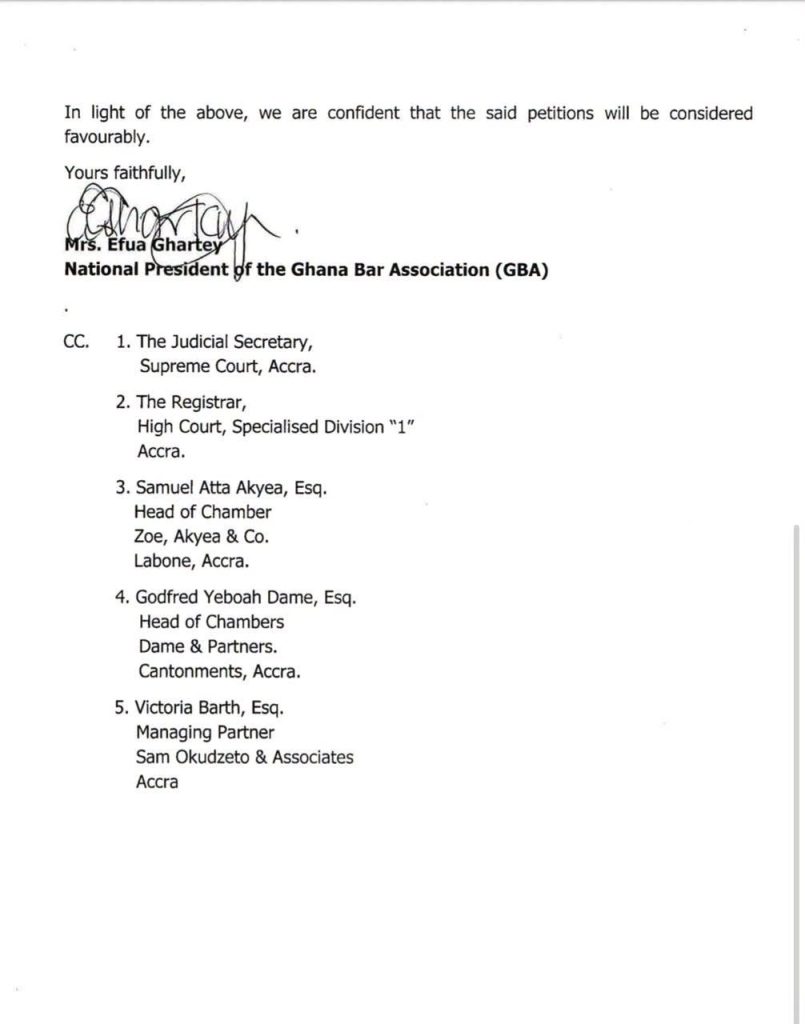
In a letter dated August 10, 2026, signed by GBA National President Efua Ghartey and National Secretary Kwaku Gyau Baffour, the Association disclosed that it was acting on petitions from Zoe, Akyea & Co, Dame & Partners, and Sam Okudzeto & Associates.
The firms raised concerns over court notices served on them pursuant to warrants authorising certain judges to continue part-heard criminal cases during the vacation period.
Citing Order 79, Rule 4 of the High Court (Civil Procedure) Rules, 2004 (CI 47), the GBA reminded the Judiciary that the High Court observes three annual vacations, with the longest, running from August 1 to September 30, intended to provide lawyers, judges, and judicial staff with a well-earned respite following the heaviest term in the legal calendar.
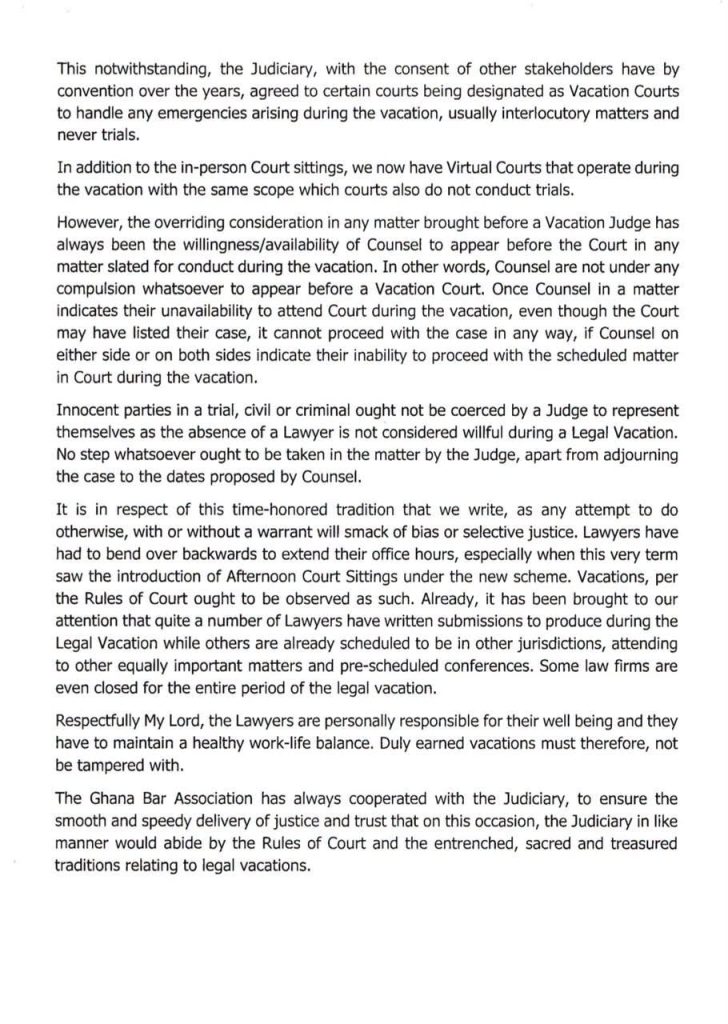
While acknowledging that Vacation Courts and Virtual Courts are conventionally available to handle emergencies such as interlocutory applications, the GBA emphasised that these courts are not mandated to conduct full trials.
It further stressed that the willingness and availability of counsel remain the overriding considerations for any matter listed before a Vacation Judge, and that lawyers cannot be compelled to attend court during the recess.
“Once Counsel in a matter indicates their unavailability to attend Court during the vacation, even though the Court may have listed their case, it cannot proceed with the case in any way,” the letter stated, adding that this principle holds regardless of whether one or both parties are unable to proceed.
The Association argued that no party in a civil or criminal trial should be coerced into self-representation due to the absence of their lawyer, particularly when such absence during the legal vacation is not deemed wilful.
It maintained that, in such circumstances, the court should take no step beyond adjourning to dates proposed by counsel.
The GBA cautioned that any attempt to force proceedings during the vacation, warrant or not, “will smack of bias or selective justice.”
It noted that lawyers have already extended their working hours this term due to the introduction of Afternoon Court Sittings, and that many have critical submissions to finalise, pre-arranged conferences in other jurisdictions, or have completely shut down their firms for the recess.
Describing the legal vacation as a duly earned entitlement essential to the well-being and work-life balance of legal practitioners, the GBA urged the Judiciary to reciprocate the Bar’s long-standing cooperation by respecting the Rules of Court and the “entrenched, sacred and treasured traditions” surrounding the vacation period.