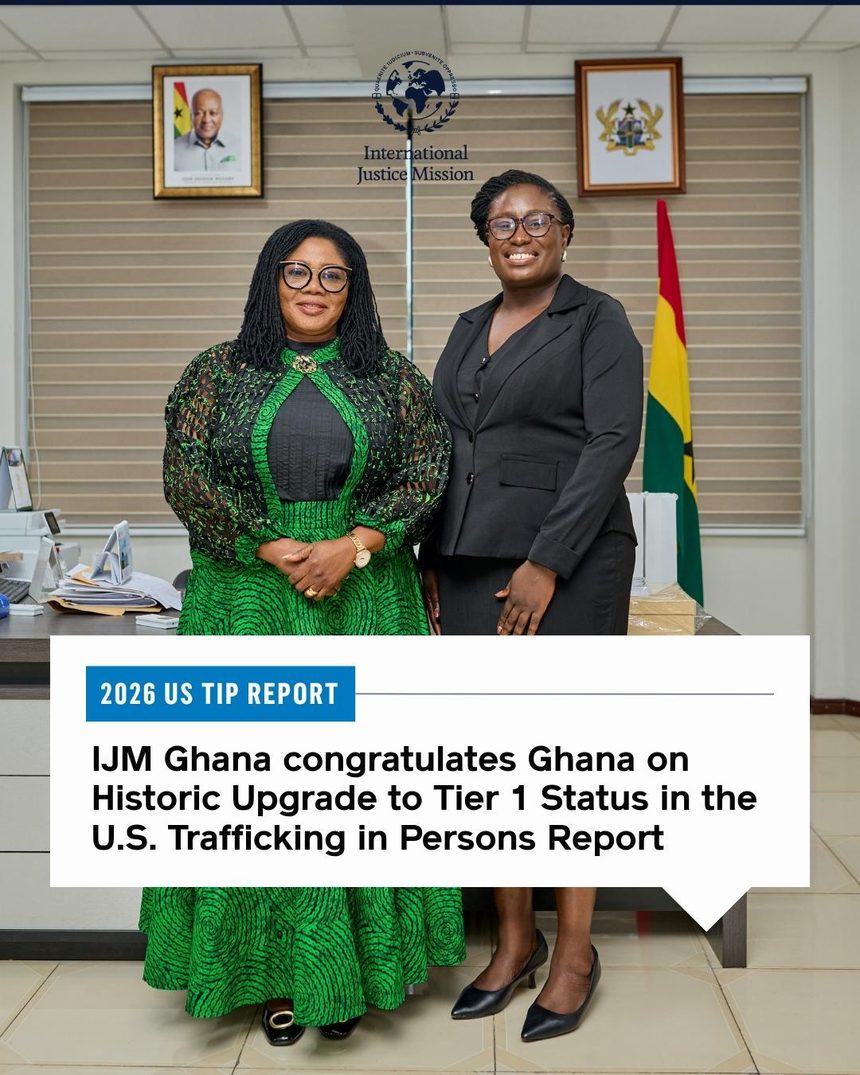
The International Justice Mission (IJM) Ghana has called for increased investment in victim protection and stronger action against child trafficking following Ghana’s elevation to Tier One in the 2026 United States Trafficking in Persons Report.
The organisation said the improved ranking should serve as a platform for addressing persistent trafficking risks. These include the exploitation of children, inadequate shelter facilities, and the growing use of technology to recruit and exploit vulnerable people.
Ghana was upgraded from Tier Two to Tier One after making significant progress in combating human trafficking during the reporting period.
The report said the government prosecuted 212 alleged traffickers, secured 28 convictions, and identified 2,331 trafficking victims in 2025, all of whom were referred to the appropriate support services.
In a statement responding to the report, IJM Ghana commended the Government and other stakeholders for the progress but cautioned against treating the achievement as the end of efforts to combat trafficking.
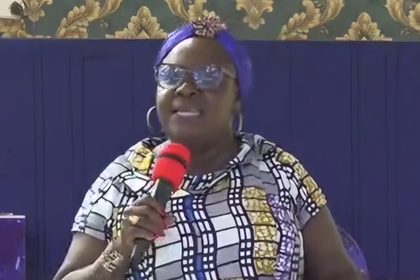
“Ghana’s elevation to Tier 1 status is a significant national achievement that reflects the power of coordinated action and collective commitment,” Madam Anita Budu, IJM’s Director for the West Africa Programme, was quoted as saying.
“At the same time, we recognise that thousands of children and vulnerable adults remain at risk of trafficking and exploitation.”
The statement said the report highlighted the continued exploitation of children in fishing on Lake Volta and coastal communities, as well as in domestic work, street hawking, agriculture, artisanal mining, quarrying and herding.
It also raised concerns about traffickers using technology and fraudulent job offers to recruit and exploit victims, calling for specialised training to strengthen the capacity of investigators to tackle cyber-enabled trafficking.
IJM Ghana identified limited shelter capacity, particularly for adult survivors, as another challenge requiring increased investment, alongside improved services for survivors and greater support for vulnerable rural communities.
The organisation commended the Ministry of Gender, Children and Social Protection and its Human Trafficking Secretariat for coordinating national anti-trafficking efforts.
It also acknowledged the contributions of law enforcement agencies, the Office of the Attorney-General, civil society organisations, the media, faith-based groups, and traditional leaders towards ending child trafficking.
IJM Ghana called for sustained collaboration and adequate resources for frontline institutions to strengthen investigations, prosecutions and victim support.
It said the achievement should inspire renewed efforts to protect vulnerable people and ensure traffickers were held accountable.
GNA