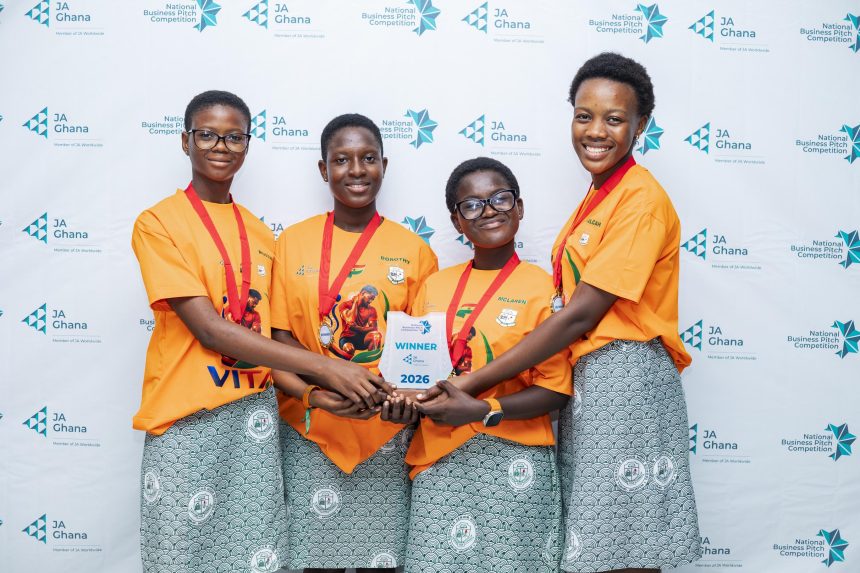
Adonten Senior High School (SHS) from the Eastern Region has emerged as the winner of the 2026 National Business Pitch Competition (NBPC), which seeks to equip young people with entrepreneurial, financial literacy and innovation skills.
Aburi Girls’ SHS, also from the Eastern Region, placed second, while Archbishop Potter Girls’ SHS from the Western Region took the third position at the competition held in Accra on Saturday.
The winning team from Adonten SHS presented Twist, a proposed business solution that developed therapeutic heat wraps for the waist, knees and other joints to provide warmth, comfort and relief from muscle and joint discomfort.
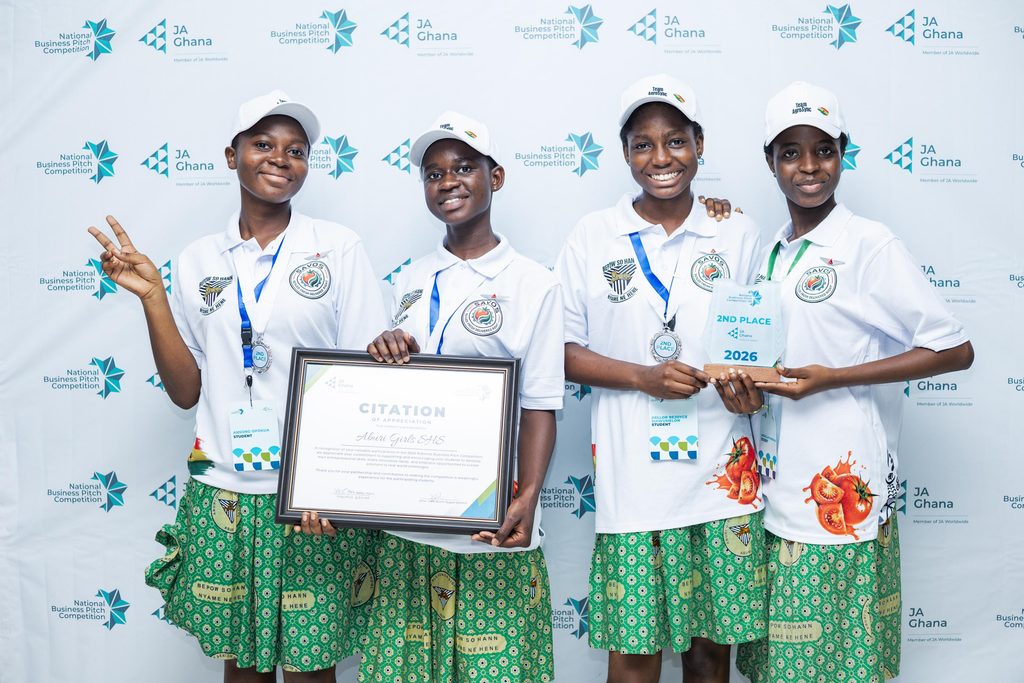
Aburi Girls’ SHS presented Savos Tomato, a solution designed to reduce tomato spoilage during transportation and add value to produce.
The proposal involved a ventilated, room-temperature transportation van to safely convey tomatoes, alongside an artificial intelligence-assisted sorting system that separated soft tomatoes from firm ones.
While firm tomatoes would be sold fresh, softer tomatoes would be repurposed into products such as shito and ketchup, helping to reduce waste while creating additional economic value.
Archbishop Potter Girls’ SHS also proposed Aya Care, a healthcare services application designed to help users locate nearby hospitals and pharmacies.
The application also featured an AI-assisted handwriting interpretation system intended to help users understand doctors’ handwritten prescriptions and identify the medications prescribed.
As part of the prizes, the Adonten SHS team received GH¢10,000, a two-door refrigerator and five power banks, in addition to the opportunity to represent Ghana at the Regional Company of the Year Competition in Cape Town, South Africa, later this year for emerging as the winner.
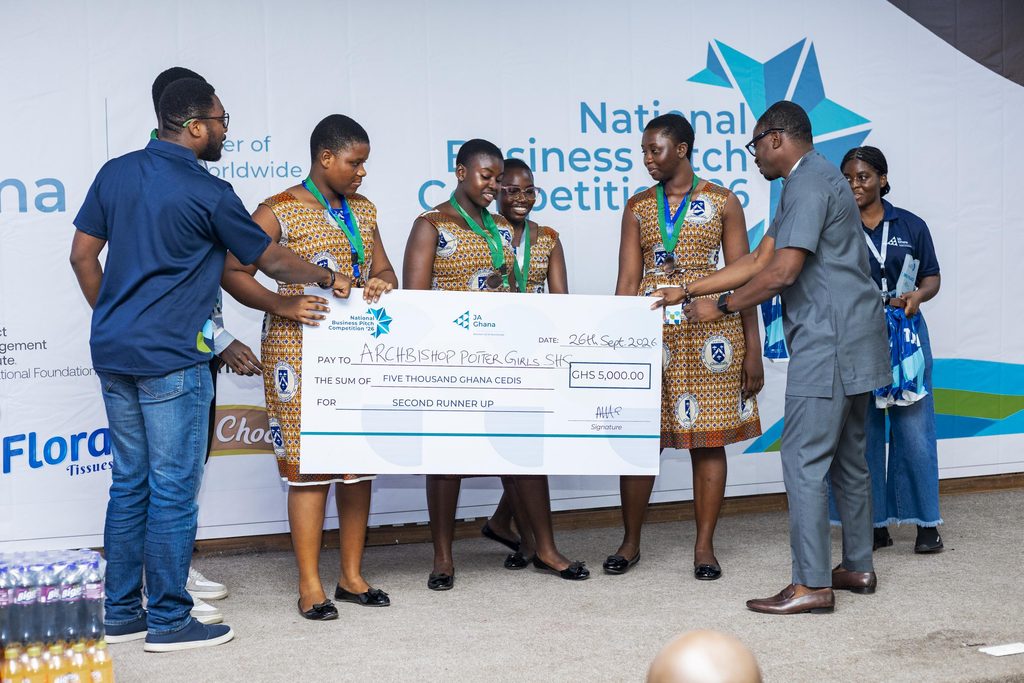
Aburi Girls’ SHS, which placed second, received GH¢7,000 and five power banks, while Archbishop Potter Girls’ SHS received GH¢5,000 and five power banks for placing third.
Other schools that competed in the finals were Keta SHS, Presec Boys, Legon and St. Peter’s SHS.
The competition, organised by Junior Achievement Ghana (JA Ghana), brought together student companies from participating second-cycle schools to showcase business ideas, innovative solutions and entrepreneurial skills developed through the JA Company Programme.
Speaking at the event, Mr Edem Amesu-Addor, Executive Director of JA Ghana, said the competition was part of a broader 16-week programme designed not merely to produce winners but to develop an entrepreneurial mindset among young people.
He said the programme encouraged students to identify a problem, understand their target consumers and develop solutions that addressed real needs before starting a business.
“Before you even embark on a business, first ask: who am I targeting? What is my problem?” he said.
Mr Amesu-Addor said that, beyond the competition, JA Ghana connected participants with partners who could provide mentorship and incubation support to help them develop their businesses beyond the programme.
He said JA Ghana’s work focused on financial literacy and capability, entrepreneurship, and digital awareness and safety, with the broader objective of preparing young people to participate meaningfully in the global economy.
He explained that innovation was no longer simply about producing an idea, but about finding ways to improve existing ideas through technology, creativity, collaboration and new ways of thinking.
“Entrepreneurship is not about having a perfect idea. It’s about having the courage to test your idea and learn from failure,” he said.
Dr Michael Wilson, a Computer Engineer and Research Scientist, who delivered the keynote address, urged the students to view problems in society as opportunities to create businesses, jobs and value.
Currently, he explained that Africa was producing more people entering the labour market than the number of jobs being created, making entrepreneurship and job creation increasingly important.
He challenged the students to move beyond asking who would employ them after school to asking, “Who will I employ? What job can I create? What value can I add?”
Dr Wilson reiterated that innovation did not necessarily require creating something entirely new, but could involve improving an existing product or process to make life easier.
He cited mobile money as an example of an innovation that built on existing systems for transferring money, while creating new opportunities and jobs.
He encouraged the students to “read, watch with the eye of an entrepreneur” and pay attention to everyday complaints and challenges as potential opportunities for innovation.
He also urged the young entrepreneurs to use artificial intelligence responsibly as they incorporated technology into their solutions.
The NBPC is the culminating event of JA Ghana’s Company Programme, which gives students practical experience in developing and presenting business ideas while receiving feedback from professionals.
The 2026 competition was held on the theme, “Augmented Innovation,” which focused on improving ideas and solutions through technology, creativity and collaboration.
The event brought together students, teachers, mentors, judges, parents, partners and other stakeholders to celebrate youth entrepreneurship and innovation in Ghana.