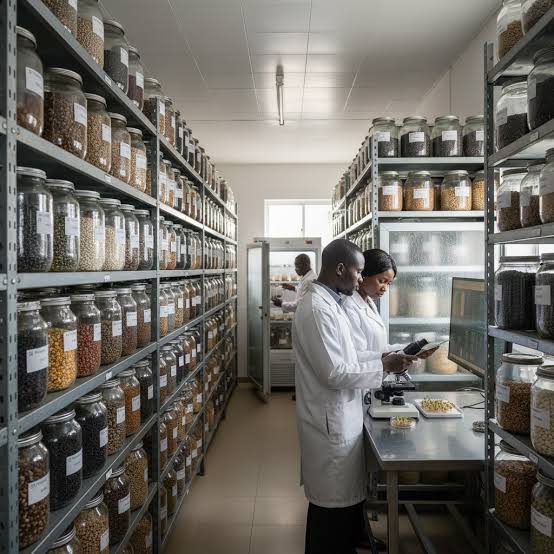
Ghana has deposited 422 germplasm accessions at the Svalbard Global Seed Vault in Norway as part of efforts to safeguard the country’s plant genetic resources against climate change, pests and disease outbreaks.
The Council for Scientific and Industrial Research-Plant Genetic Resources Research Institute (CSIR-PGRRI) at Bunso in the Eastern Region spent about US$15,000 to duplicate and deposit the genetic materials under an international conservation initiative aimed at preserving critical crop diversity for future generations.
Dr Rashied Tetteh, Deputy Director of CSIR-PGRRI, said in an interview that the safety duplication exercise was necessary to protect Ghana’s invaluable plant genetic resources from emerging threats.
“Ghana had the opportunity to safely duplicate the materials in October 2023 through the support of the Global Crop Diversity Trust in Germany, and we were able to duplicate about 422 accessions of our germplasm,” he said.
He said the duplicated materials had been deposited at the Svalbard Global Seed Vault in the Svalbard Archipelago, Norway, where they serve as a secure global backup of Ghana’s genetic resources.
According to Dr Tetteh, Ghana was among five African countries selected under the Seeds for Resilience Project, alongside Nigeria, Kenya, Ethiopia and Zimbabwe, to participate in the conservation initiative.
“Five countries were selected from Africa, and each country was asked to select the species of interest,” he said. “We therefore had the opportunity to select five crop species for safety duplication.”
The selected crops were maize, rice, cassava, cowpea and indigenous garden egg varieties, which are staple food crops and among the most sought-after species for research and crop improvement.
Explaining the selection, Dr Tetteh said the crops were chosen because of their importance to scientific research and breeding programmes.
“The decision that informed the selection was that, at the gene bank, those are the crops that are highly demanded for research purposes and therefore crop improvement,” he said.
Before the seeds were shipped to the global seed vault, Ghana completed a first-level duplication process at the International Institute of Tropical Agriculture (IITA) in Ibadan, Nigeria, in line with international conservation protocols.
“Prior to depositing the seeds at the global seed vault, there was the need for a backup. You also have to have a first-level duplication outside our jurisdiction. Ghana had the opportunity to duplicate at IITA in Nigeria,” he explained.
Dr Tetteh said maintaining duplicated genetic materials came at a considerable financial cost, which limited the number of accessions that could be deposited.
“Duplications cost us about US$15,000 to undertake this activity. That’s why the number of accessions duplicated was limited,” he said.
He disclosed that before the materials were sent abroad, an agreement was signed to guarantee Ghana the right to request and retrieve the seeds whenever the need arose.
Dr Tetteh said the arrangement was particularly important because of the challenges associated with maintaining germplasm collections at optimum storage temperatures locally due to funding constraints.
He said safety duplication remained a critical strategy for protecting genetic diversity and strengthening climate resilience.
According to him, the duplicated collection provides an additional layer of security to ensure Ghana’s plant genetic resources remain protected and accessible, even in the event of unforeseen circumstances affecting the national gene bank.
“This serves as a secure global backup to protect Ghana’s invaluable plant genetic resources for future generations,” Dr Tetteh said.
“The first level of duplication deposited at IITA in Nigeria provides another layer of security, ensuring that Ghana’s plant genetic resources remain protected and accessible.”
GNA