President John Dramani Mahama has announced that Ghana will ban the export of mineral ores by 2030.
“I have set a clear goal that by 2030, raw mineral ores should no longer leave our shores. Our alumina, manganese, iron, lithium, and other minerals must support processing and industrial development here at home.”
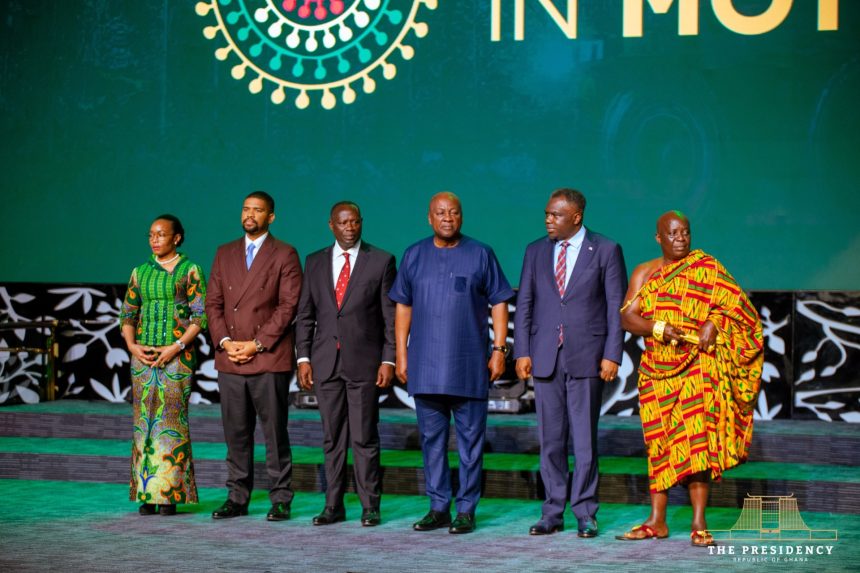
President announced this in his address at the opening of the Second Edition of the Mining in Motion Summit in Accra
The two-day Summit is on the theme “One Continent.” One Voice on Minerals. Aligning Africa’s Mineral Future.
He said the Government would pursue a phased prohibition on exports of unprocessed ores, supported by the necessary legal measures, mineral-specific requirements, and transparent implementation timetables, declaring that they had already imposed a ban on the export of iron scrap and non-ferrous metals.
He noted that for generations, ships had departed from Ghana’s ports, carrying Ghanaian manganese and bauxite, much of which had supplied industries in other parts of the world, while they had imported the finished products made from these mineral ores.
“Opportunities for skilled employment and technological learning have passed us by. We have a responsibility to change this path, and the Accra Reset provides a framework for doing so,” President Mahama said.
He noted that the ultimate objective of the Accra Reset was to affirm that their people must have greater control over the decisions and productive capabilities that shape their future, which control must be exercised through capable institutions and accountable leadership, and the result must be that sovereignty improves the lives of their people.
He said for minerals, this means owning their own resources, extracting them responsibly, processing them domestically and competitively, adding that it will link their mineral value chains to the industries their economies need.
President Mahama said the transition to cleaner energy had intensified demand for critical minerals, and that Africa must seize this opportunity to secure a stronger position in manufacturing, supported by skills, technology, and reliable supply networks.
He said Ghana had laid the foundation for this work and that the Ghana Integrated Aluminium Development Corporation provided a framework for linking bauxite to aluminium refining, and then to aluminium smelting and manufacturing.
President Mahama noted that the Ghana Integrated Iron and Steel Development Corporation would connect iron ore development to commercial steel production.
He said through the Ghana Gold Board and its gold refining policy, they were working to retain more value through assaying, refining, and related services.
“Salt also belongs to this vision. Beyond its traditional uses in catering, salt can support caustic soda production for aluminium refining and chlorine production for water treatment,” he stated.
The President said developing these links responsibly could strengthen industry and reduce dependence on imported chemicals.
“Legislation alone cannot build an industry. The government must create conditions that enable enterprises to invest, produce, and compete.”
President Mahama said investors needed predictable rules, clear institutional responsibilities, and efficient and prompt approvals and that communities need confidence that license conditions and environmental obligations would be enforced.
He said refineries and smelters required reliable, competitively priced energy, adequate water, and secure supplies of raw materials, adding that roads, railways, and ports must link production to markets.
He said financing must support viable projects through disciplined public investment and credible opportunities for private and development capital.
He said African copper could supply cable manufacturers, stating that aluminium could support power systems, while steel could serve their railways, construction, and mining industries.
The President said universities and technical institutions must collaborate with industry to solve production problems and prepare young people for skilled employment and that opportunities also existed in equipment maintenance, fabrication, laboratories, software, and recycling.
Madam Francisca Tatchouop Belobe, the African Union Commissioner for Economic Development, Tourism, Trade, Industry, and Minerals, citing the success story of the Ghana Gold Board, said Ghana offered valuable lessons to the rest of Africa.
In attendance at the event was Vice President of Liberia, Jeremiah Kpan Koung, while the Asantehene Otumfuo Osei Tutu II was represented by Omanhene of Asumenya Odeneho Okyere Kusi Ntrama II.