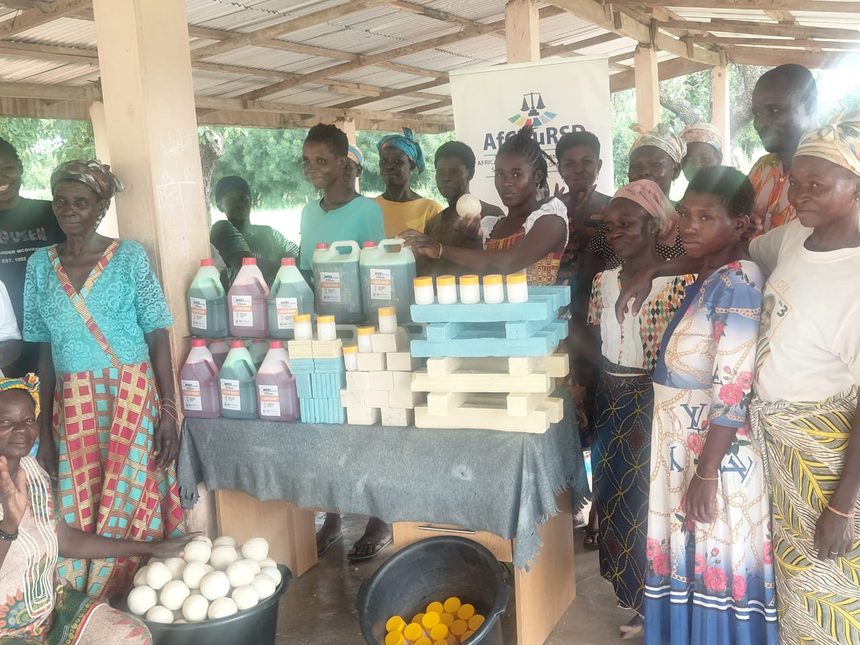
A total of 115 women at Goriyiri and Vogoni communities in the Nadowli-Kaleo District and Duori-Tangkuri in the Jirapa Municipality have received skills training in household detergent and cosmetics production as alternative sources of livelihood.
The women were trained in the production of different types of soap, including bar, brilliant, BF and liquid soap, and pomade making.
The initiative by the African Centre for Human Rights and Sustainable Development (AfCHuRSD) was to help reduce the economic vulnerabilities of the women as part of its Girls and Women Economic Empowerment, Livelihood and Participation in Leadership (GWEEL).
It would also contribute to achieving Sustainable Development Goals (SDGs) 1 and 5 on poverty reduction and gender equality, respectively.
Some participants who demonstrated competence during the training were provided with start-up kits to enable them to establish small-scale businesses in their communities.
Speaking at the training at Vogoni, Madam Bernice Naah, Executive Director of AfCHuRSD, entreated the beneficiaries to establish small businesses with the skills they had acquired to help improve their income status.
She encouraged the women to patronise their own products and market them in other communities to create demand and grow their businesses.
Madam Naah said producing the items for their household use would also help the women save money for their children’s education and other family needs.
Some of the beneficiaries, who spoke to the Ghana News Agency (GNA), expressed gratitude to AfCHuRSD for the initiative, since it would enable them to become economically productive.
“We are very grateful for this opportunity because a lot of us in our area, how to get these skills is not easy”, Madam Alice Dakubo, a beneficiary, said.
She said the knowledge acquired would enable the women to support their families.
She said: “Our men alone cannot take care of us, but by acquiring this knowledge, we are going to use it to support our families and our husbands.”
Madam Dakubo, however, appealed to the government, and philanthropic organisations and individuals to provide them with financial support to start businesses based on the skills they had acquired.
She encouraged her colleagues to make good use of the skills, as it would help improve their incomes, support their children’s education and promote their personal development.
In a related development, the NGO engaged women’s groups in Daffiama and Nadowli on livelihood opportunities.
The women, who were predominantly farmers, expressed interest in poultry farming, particularly during the off-farming season, and appealed for support in that regard.
Madam Naah assured of inviting agricultural extension officers to provide the women with technical guidance and support before the distribution of the chickens.
The NGO also used the opportunity to sensitise the women on gender-based violence and the Affirmative Action Gender Equity Act, 2024 (Act 1121) to promote awareness of their rights and participation in development.
GNA