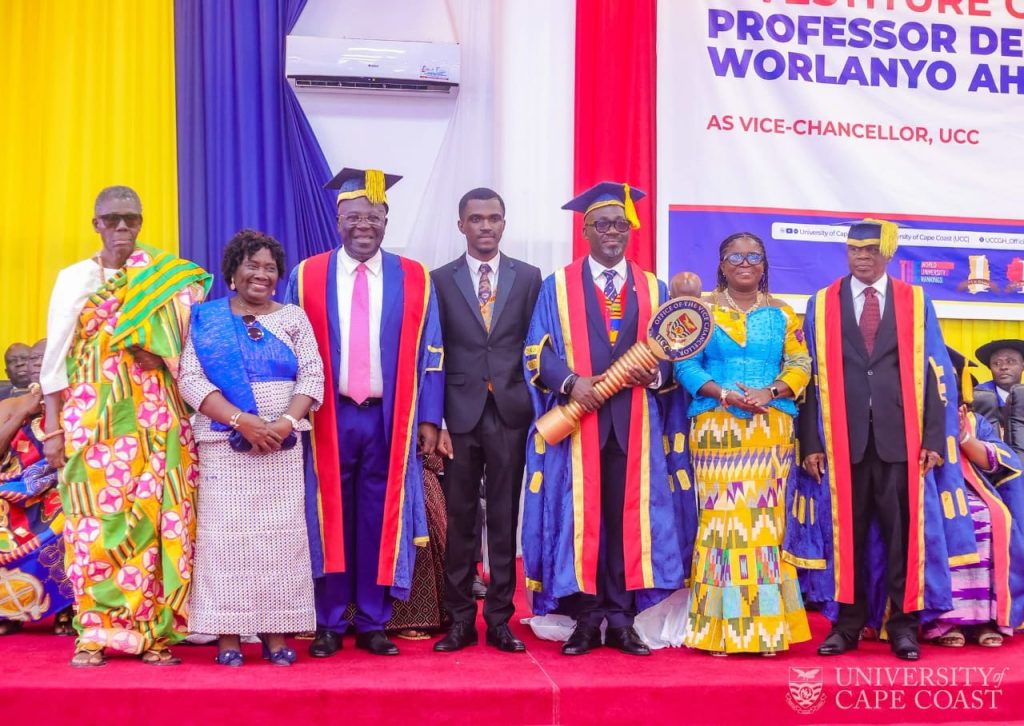
The University of Cape Coast (UCC) has formally inducted Professor Denis Worlanyo Aheto as its 12th Vice-Chancellor, with a charge to reposition the institution as a hub for practical and skills-based learning to produce competent graduates to solve real problems.
Sir Sam Eson Jonah, the Chancellor of the University, noted that the disruptive impact of Artificial Intelligence (AI), had made it untenable for universities to continue awarding degrees based solely on theoretical knowledge, without proven competence.
“I am proposing today that the University of Cape Coast become the first in Africa to build a full faculty of degree-awarding vocational education, Bachelor and Master degrees in Applied Skills, with the rigour of the academy and soul of the workshop.
He proposed the award of a Bachelor of Applied Skills in Renewable Energy Systems for instance, where students could not graduate until they had personally installed and maintained a working solar installation.
He also suggested a degree in Coastal and Aquaculture Enterprise that would build on the fisheries legacy of Professor Aheto, where students would establish a functioning fish farm with economic viability as part of the programme.
Prof. Aheto succeeds Prof. Johnson Nyarko Boampong, whose tenure as Vice-Chancellor officially ended on September 18, 2025.
His appointment was confirmed by the University’s Governing Council in May this year having acted in the position for 10 months, while he played his substantive role as the Pro Vice-Chancellor for 19 months.
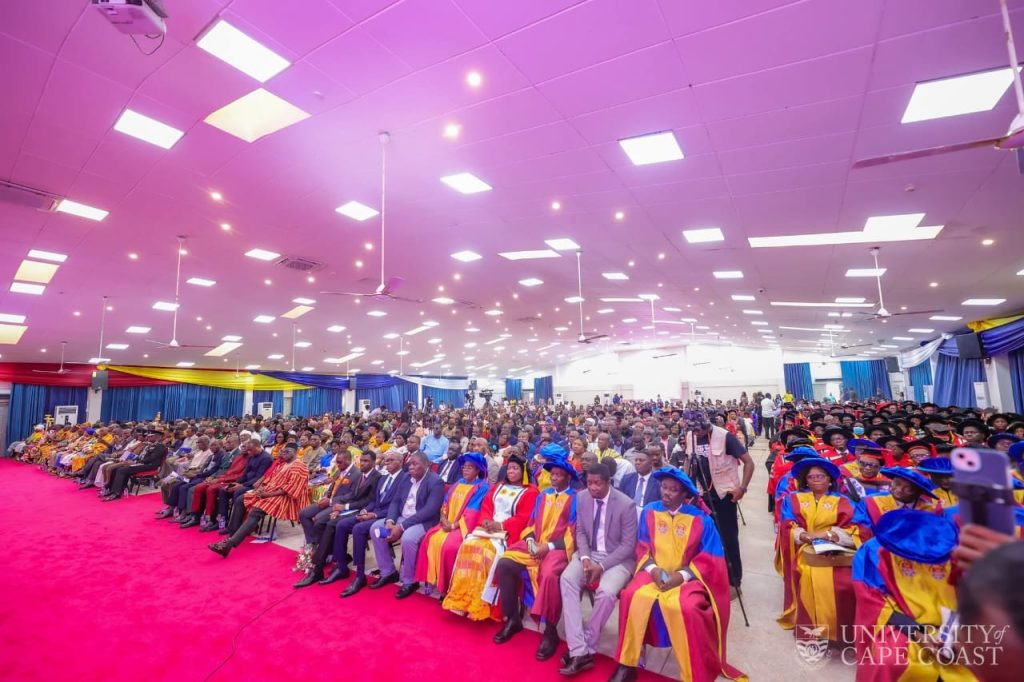
In his honour, the university conveyed a special and colourful congregation for his investiture.
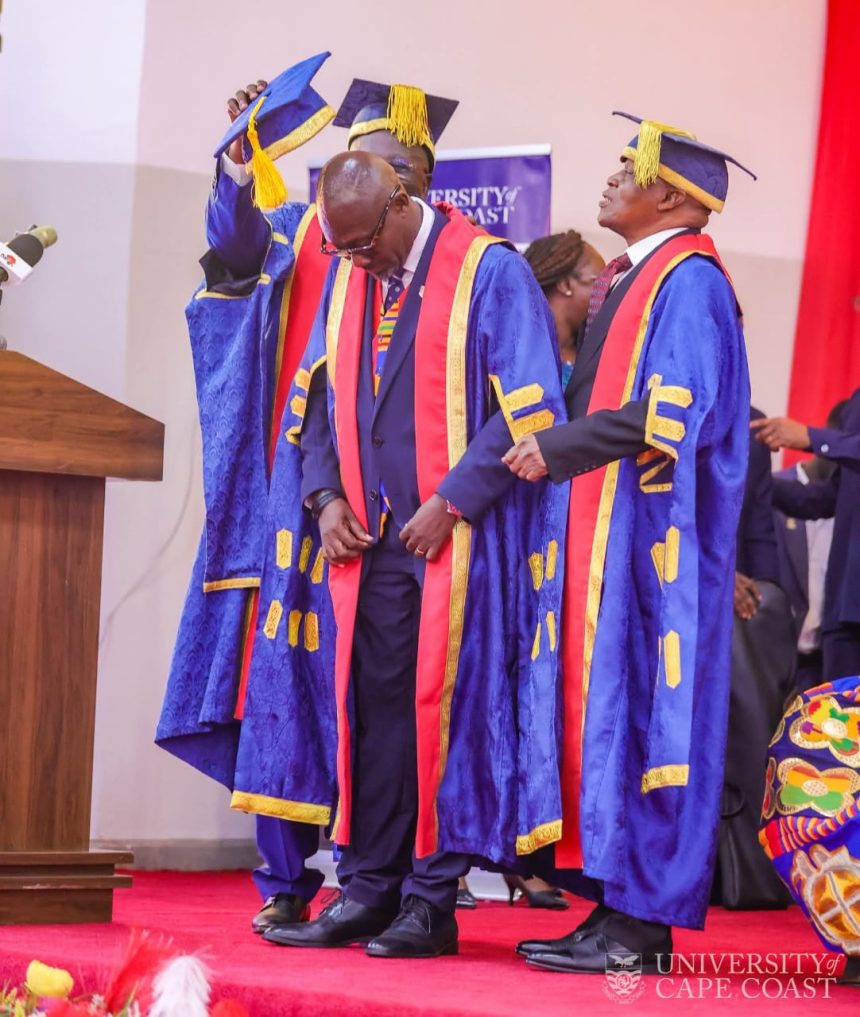
He was robbed by the Chancellor and Justice William Atuguba, the Chairman of the university’s Governing Council, immediately after which he took the oath of office.
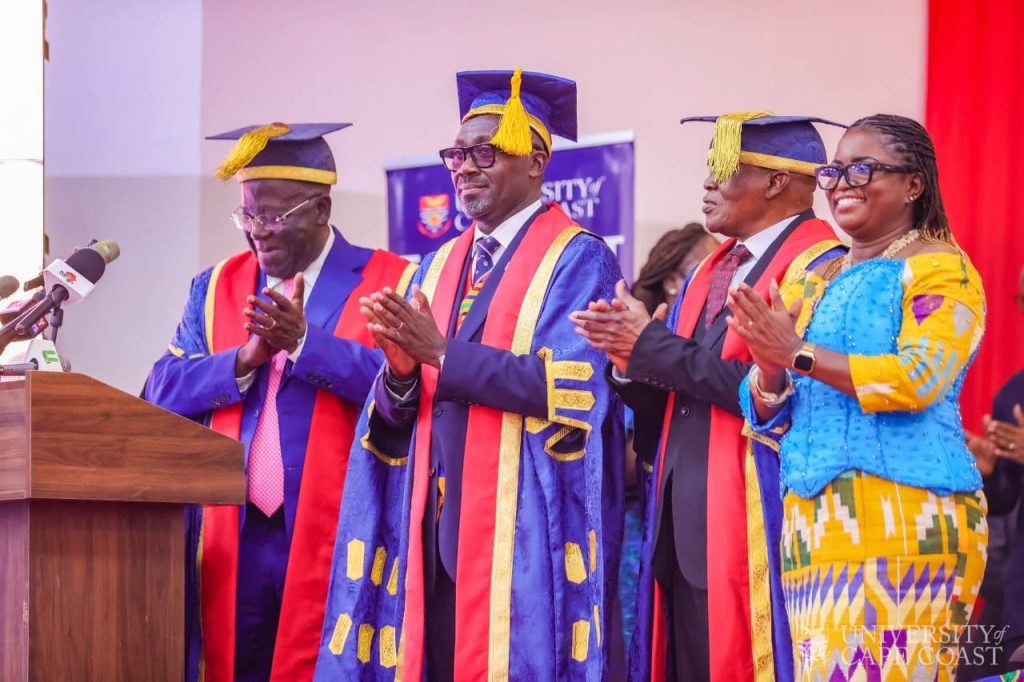
Sir Jonah, addressing the congregation, stressed that in a world where machines could reproduce knowledge faster than humans ever could, a degree would only be useful if graduates could perform tasks machines could not.
Citing Germany’s dual vocational training system, China’s overhaul of thousands of university programmes and the growing demand for skilled trades in the United States, he reiterated the need to embrace practical, skills-based education.
“Guard the standards of this University with your life. A devalued degree helps no one. Break the wall between the academy and the workshop and let no programme survive that cannot answer the question, “What can your graduate do?”
“Put a lecturer of practice – a master welder, a master nurse, a master farmer – beside every professor of theory, and pay them both with honour,” he said.
The Chancellor said AI might take over knowledge-based tasks, but occupations such as construction, electrical installation, plumbing, healthcare and other hands-on professions would become even more valuable as they depended on human capabilities beyond technology.
He urged Ghana and the rest of Africa to adopt AI as a collaborator in driving development and innovation rather than a disruption or replacement for human labour.
He observed that leading global universities were already adapting by integrating AI across all disciplines rather than treating it as a standalone subject, citing the Massachusetts Institute of Technology (MIT), Stanford and Harvard.
Sir Jonah acknowledged that the establishment of the proposed faculty for vocational skills would require some time and proposed three immediate steps to keep the initiative alive.
He called for the establishment a student AI club that would leverage AI to build real things and solve real problems.
To further the cause, he called for structured mentorship from Ghana’s and Africa’s diaspora, urging UCC to connect students with AI experts abroad to provide guidance, inspire innovation and expose them to global standards of excellence.
To build a stronger foundation, he suggested, the introduction of a project-based curriculum which would require students to acquire specific skills to complete tangible projects.
To keep the proposed transformation running, the Chancellor entreated the university to be more innovative in mobilising resources and expressed confidence in the Vice Chancellor’s ability to drive the reforms.
“From one centre, Prof. Aheto has mobilised over $30 million into this University, funded more than four hundred scholarships, trained over fifty PhDs, and grown a national centre into an Africa Centre of Excellence,” he noted.
The Vice-Chancellor accepted the challenge from the Chancellor, pledging to approach his new role with innovation, creativity, and dedication.
Prof. Aheto unveiled a four-year agenda to transform the institution through digital innovation, research excellence, infrastructure expansion and sustainable financing.
He said his vision was “to provide strategic leadership to foster a transformative, inclusive and diverse academic environment that empowers excellence in research, teaching and learning and outreach for wider impact on society.”
Among other things, he announced plans to establish a College of Engineering and Built Environment, and introduce new academic programmes in areas including AI, Cybersecurity, Veterinary Medicine, Dentistry, Architecture and Special Languages to meet emerging national and global demands.
Prof. Aheto also highlighted the launch of the UCC E-Campus in partnership with Astra Learning, describing it as an additional pathway to expand access to quality higher education.
“We estimate to enrol approximately 10,000 students annually on the virtual platform,” he said, adding that the initiative would complement rather than replace the university’s regular, sandwich and distance learning programmes.
He also further announced the establishment of the Africa Ocean Institute and the Africa Food Integrity Centre to strengthen research, innovation and policy engagement, adding that plans were far advanced to create a Centre for Ecological and Terrestrial Sustainability.
He pledged to improve teaching and learning facilities, expand student accommodation through public-private partnerships, strengthen campus digital infrastructure and diversify the university’s revenue sources.
“Together, we will secure UCC’s future as the leading university that shapes knowledge, drives national development and prepares graduates to excel in an increasingly dynamic and interconnected world,” he said.
Prof. Ahmed Abdulai Jinapor, the Director-General of the Ghana Tertiary Education Commission (GTEC), speaking on behalf of the Minister of Education, urged Prof Aheto to lead the institution in producing graduates of character and competence capable of addressing Ghana’s development needs.
He expressed confidence in the new Vice-Chancellor’s ability to build on UCC’s legacy of academic excellence and steer the institution through emerging challenges, including quality assurance, funding and the need to equip graduates with industry-relevant skills.
Prof. Jinapor reaffirmed GTEC’s commitment to safeguarding the integrity of Ghana’s tertiary education system through strict quality assurance measures, including action against unaccredited institutions and programmes.
He urged prospective students to pursue accredited tertiary education in Ghana, assuring UCC of the Commission’s continued partnership in maintaining globally respected standards.
Prof. Aheto is a Professor of Coastal Ecology and Interdisciplinary Oceans Studies and Director of the Centre for Coastal Management Africa Centre of Excellence in Coastal Resilience (ACECoR) at the University of Cape Coast (UCC).
With more than 15 years of scientific project management experience, he has led major donor-funded initiatives in marine, coastal and fisheries management supported by the World Bank, African Union, USAID and DANIDA.
He is widely recognised for his research on coastal and marine ecosystem conservation, small-scale fisheries, marine spatial planning, wetlands ecology and marine conflict management, with an extensive record of publications in indexed journals.
NA