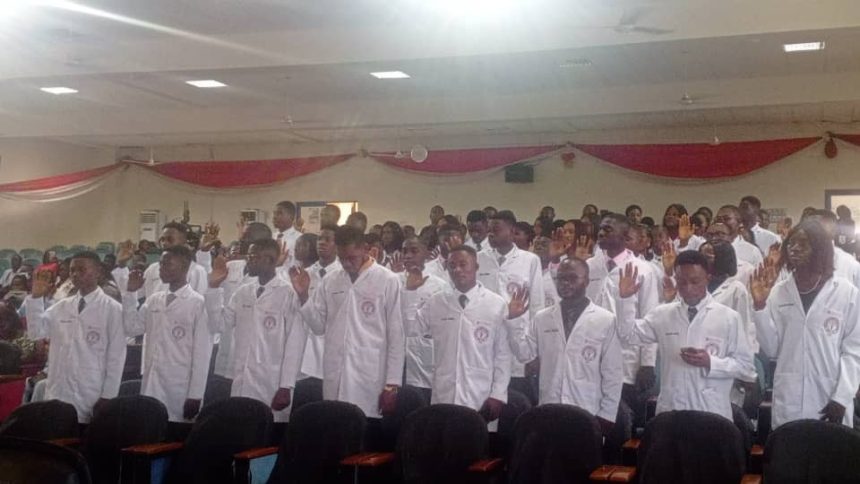
The School of Optometry and Vision Sciences (SOVS) at the University of Cape Coast (UCC), on Thursday, held its 2nd White Coat ceremony to formally commence the clinical phase of training for 73 Level 400 students who are being prepared to become eye care professionals.
Held on the theme: “Eyes on the future, refractive error correction today, success tomorrow,” the ceremony featured the formal robing of students in the Optometrist’s traditional white coat, a symbol of professionalism and compassion in patient care.
The students also took the Oath of Optometry, pledging a lifetime of service that prioritised patient welfare, ethical conduct, continuous professional development, relief of suffering and the protection of patient information.
The students, currently in Level 400, are expected to complete their programme and graduate in 2028, after which they will join the nation’s cadre of eye-care professionals to help expand access to vision services across the Country.
The event brought together a cross-section of the university’s leadership, government officials, faculty and staff, alumni, health professionals and practising optometrists.
As part of the event, an alumni homecoming and support, provided opportunities for mentorship and interaction between past graduates and the new cohort as they prepared for clinical placements.
The Ghana Optometric Association also collaborated with the school to hold a symposium on refractive error.
Prof Emmanuel Kwasi Abu, Professor of Optometry and Vision Science at the UCC, in a keynote address advocated for routine school screening to detect vision problems early when treatment was simplest and most effective.
While stressing the need for affordable spectacle to ease financial barriers that kept children from learning, he emphasised the significance of locally driven research to inform relevant and impactful policies tailored to address Ghana’s needs.
He indicated that parents and teachers must be educated on the need to engage children in outdoor activities that protected their eyes and on the effects of screen overuse, to prevent myopia.
The Professor of Optometry and Vision Science also suggested that refractive error should be integrated into national health planning for sustainable funding, workforce training, and service delivery so these measures reached all children.
Lieutenant Commander Dr Prince Opuni Quarcoo the Guest Speaker, an optometrist at the 37 Military Hospital, urged the students to follow Ghana’s Optometrists’ Code of Ethics to aid professionalism, discipline and integrity as essentials for trustworthy practice.
He explained that such values protected patients, upheld the profession’s reputation and guided difficult decisions.
He further urged practitioners to always prioritise patients’ welfare, respect their views and never hesitate to seek support when needed.
Prof Denis Aheto, in a speech delivered on behalf, the Vice Chancellor of UCC, emphasised the responsibilities accompanying the white coat, urging the students to uphold high ethical standards, and safeguard patient confidentiality.
Prof Aheto urged optometry students preparing for clinicals to work with professionalism and pride, reminding them that the white coat symbolised commitment to patient-centered care, ethical practice and the trust placed in them by society.
He underscored the importance of community service, integrity, accepting responsibility, and courage in clinical settings, noting that these values were central to UCC’s training and essential for building strong patient relationships.
He reminded students that the high quality and global reputation of UCC’s education demanded high ethical standards, as their conduct would expose both the university and the wider profession.
Prof Stephen Ocansey, the Dean of SOVS, urged the students of commit to lifelong learning to address evolving eye-care challenges, particularly refractive errors affecting Ghana’s population.
He reiterated the school’s commitment to high academic standards and expanded practical, hands-on training, urging partners and stakeholders to provide funding and logistical support to sustain and scale these programmes.
Such investment, he said was crucial because it ensured the supply of modern equipment, clinical placements and instructional resources that directly enhance student competencies, patient care outcomes and the school’s ability to advance research and community eye health.