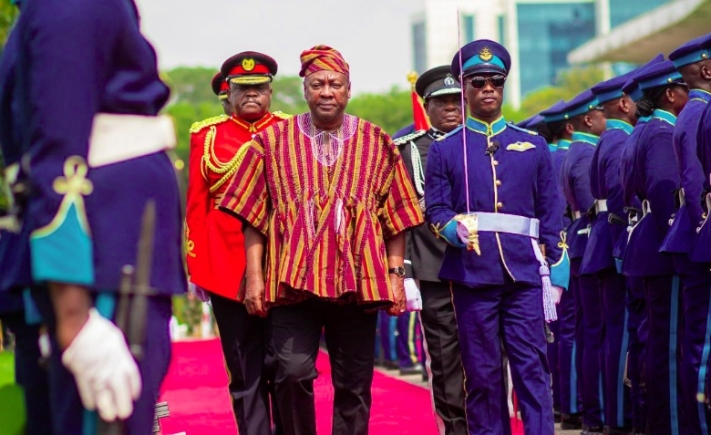
President John Dramani Mahama has rallied Ghanaians to cherish their collective achievements, strengthen national unity, and uphold patriotism as the foundation for driving sustainable development.
Delivering the 2026 State of the Nation Address to Parliament on Friday, the President emphasised that Ghana’s progress depended on a shared commitment to national values, civic responsibility, and cooperation across political, social, and economic divides.
Under Article 67 of the 1992 Constitution, the President is required to address Parliament at the beginning of each session and before the dissolution of Parliament, on the state of the nation, outlining the condition of the country and the government’s policy direction.
President Mahama declared: “Unity in moments of cultural pride has proved easier than unity in moments of political disagreement.
“If we can mobilise that same collective resolve for our development agenda, we will see real progress.”
He cited the recent incident during his visit to Zambia, where a misrepresentation of Ghanaian culture on social media was swiftly corrected through collective national effort, turning a potentially negative episode into an opportunity for cultural connection and goodwill.
“A simple mislabelling of our culture could have reduced us to a punchline. Instead, we moved with speed and confidence. We corrected the record. We turned ridicule into reach. We turned confusion into connection,” the President said.
He noted that the episode demonstrated the strength of Ghana’s national identity and the power of unity, showing “a nation that understands its brand equity, citizens aligned around a common identity, and a country that knows who we are and refuses to be defined by others.”
The President said Ghana’s history was shaped by unity in the face of adversity, including resistance to political subjugation, economic exploitation, and oppression, stressing that the same resolve was required to meet present-day challenges.
“Our pursuit of national development today demands the same unity.,” he emphasised.
“We must reject misrepresentation and distortion that detract from our collective progress. We must guard our development as firmly as we guard our identity. And we must act as one people with one purpose.”
Reaffirming his accountability, the President said ultimate responsibility for the nation’s direction rested with the Presidency.
“The buck stops with the President. I not only agree with this; every day I hold the office of President, I live by it,” he stated.
He explained, however, that nation-building was a shared enterprise, requiring sustained effort from all sectors, from policy formulation and legislation to service delivery and value creation across communities, farms, workshops, classrooms, markets, and enterprises.
“While the buck may stop at the Presidency, the work of nation-building goes beyond it; through the labour, enterprise, and civic spirit of millions of Ghanaians, whose daily efforts give policy life,” he said.
The President urged citizens to bring their full measure of energy, skill, and patriotism to the national task, noting that “no policy can substitute for civic duty, and no programme can replace the quiet discipline with which millions of Ghanaians sustain their families, serve their communities, and carry this Republic forward each day.”
Touching on the national psyche, he cautioned against an excessive focus on challenges, saying Ghanaians were often tempted to judge the nation only by its difficulties.
“We are sometimes tempted to judge our nation only by the failures and difficulties we face. But a country is not defined solely by its burdens. It is defined by the choices its people make in response to them,” he said.
He recalled that throughout Ghana’s history, citizens had repeatedly chosen steadiness over despair, cooperation over division, and purpose over cynicism, describing those choices as the deeper strength on which the nation’s future rested.
The President emphasised that unity, resilience, and shared responsibility remained the pillars for achieving sustainable development and securing a prosperous future for generations to come.