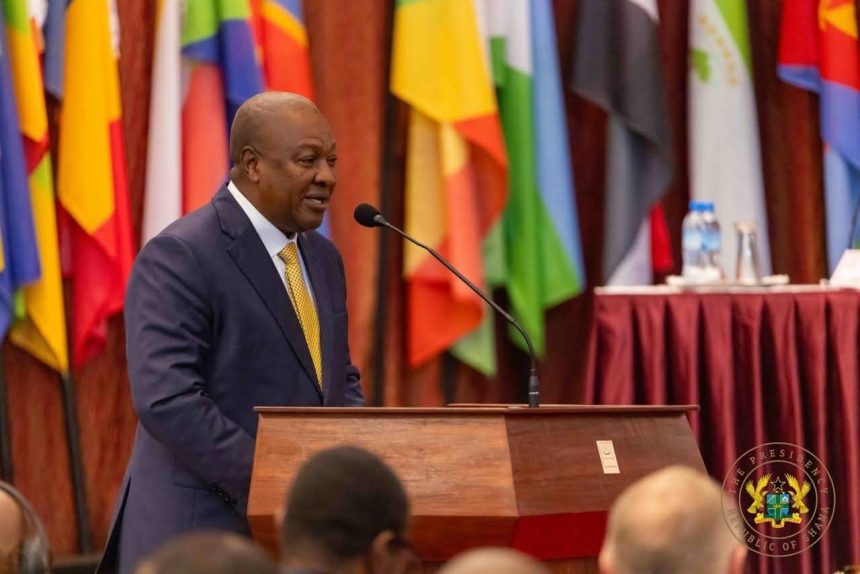
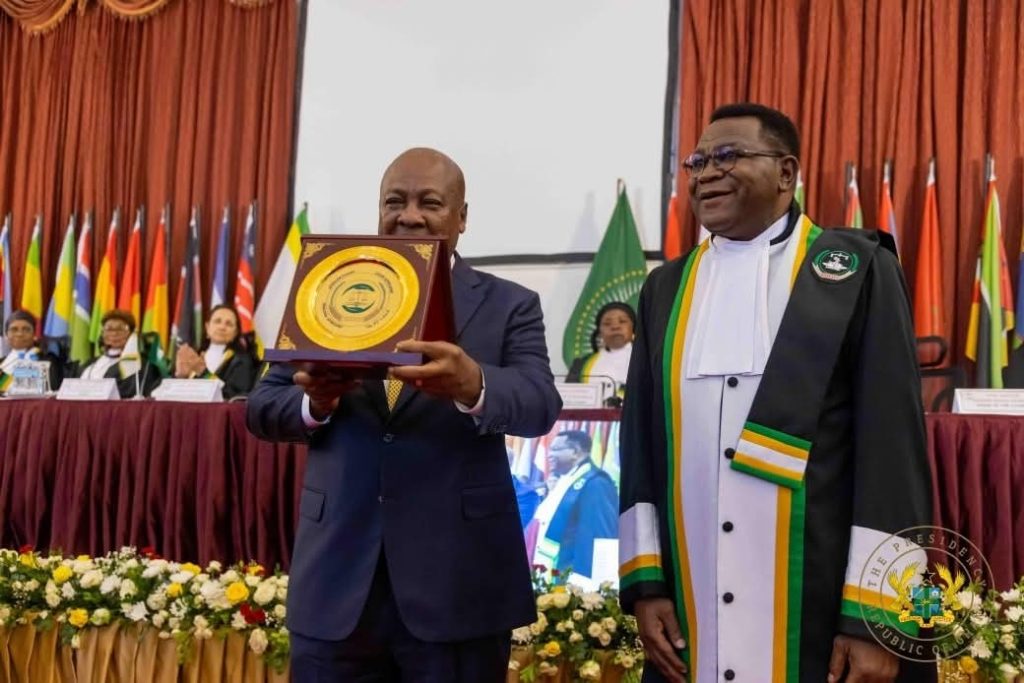
President John Dramani Mahama, at the opening of the 2026 Judicial Year and 20th Anniversary of the African Court on Human and Peoples’ Rights (AfCHPR) in Arusha, Tanzania, has noted with pride Ghana’s contribution of legal minds to the august court over the years.
He said Ghana’s Justice Sophia Akuffo served from 2006 to 2014 and rose to the position of President of the Court.
She later served as Chief Justice of Ghana from 2017 until her retirement in 2019.
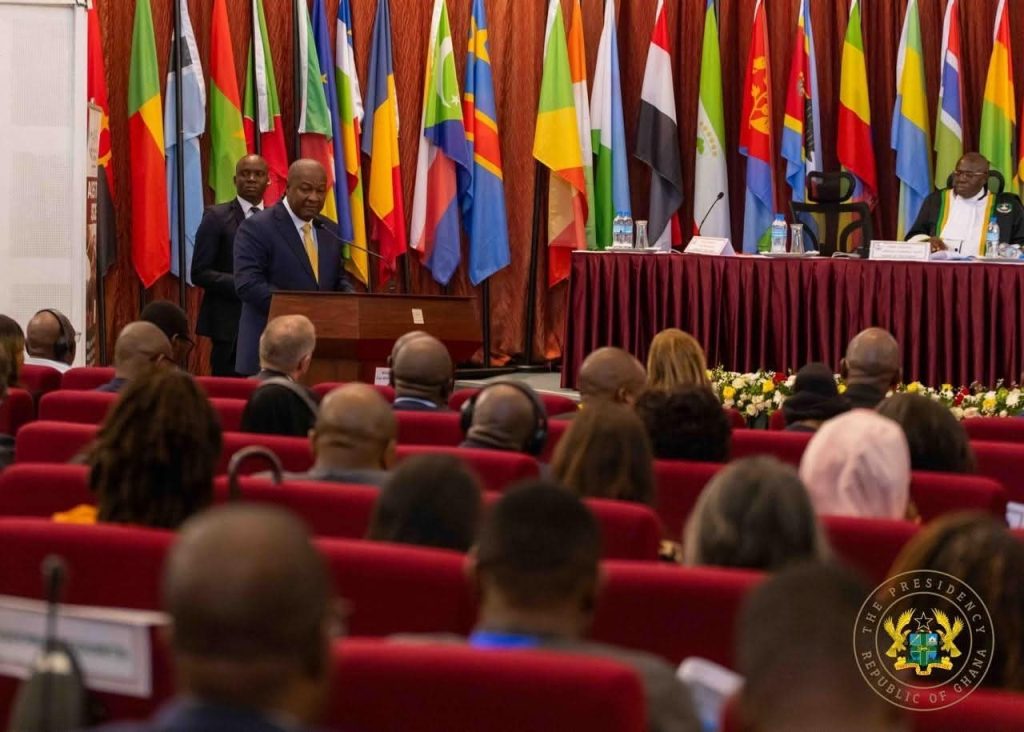
The President said Justice Sir Dennis Adjei, a respected member of Ghana’s Supreme Court, was now serving a six-year term following his 2022 election.
He noted that Africa had been blessed with many of the world’s natural resources, including gold, silver, diamonds, copper, cobalt, uranium, oil, lithium, and more.
However, at times, it becomes easy to overlook that their most significant inheritance is “our people and their cultural legacies.”
He said those who had benefited from their continent for centuries had always understood this powerful truth.
“That is why Patrice Lumumba, Eduardo Mondlane, Thomas Sankara, and Amilcar Cabral were assassinated,” President Mahama said.
“That is why the Asantehene Nana Prempeh I, over 150 members of his clan, and later Nana Yaa Asantewaa were all banished from Ghana to the Seychelles.”
He said similarly, Omukama Kabalega of Bunyoro in Uganda was also banished to Seychelles.
“That is why Sam Nujoma was forced into exile from Namibia, and Nelson Mandela was imprisoned on Robben Island, a former leper colony off the coast of Cape Town, South Africa.
“That is why Steve Biko was murdered in prison. We felt the absence of these individuals and recognised the potential that was lost.”
The President referred to” The Lost Decades of Africa”, the opening chapter of his book, “My First Coup d’ Etat” which covered Ghana’s political history from the mid-to-late 1970s until the early 1990s, when brain drain occurred, and the continent stagnated.
President Mahama said the effects of social injustice and human rights violations extend beyond individuals, stating that they impact on families and communities.
He said that although their continent comprises 55 sovereign nations, their destinies were closely linked.
President Mahama said: “Globally, many still view Africa as a single entity and refer to us collectively as “Africa”. Is it any wonder? Look at the synergy that existed between us during Africa’s era of liberation. One nation after another, in quick succession, declared freedom from colonial rule.”
Then again, when coup d’etats became a common occurrence, that tendency spread, like a contagion, through nearly every nation.
President Mahama recounted that his late father, Mr E.A. Mahama, who was a Minister under Ghana’s Founding President, Osagyefo Dr Kwame Nkrumah, went through tribulations following the overthrow of Dr Nkrumah’s Government during the 24th of February 1966, a military coup d’etat.
He said his father’s political tribulations did not end with his detention after he wrote the letter advising the Head of State in the early 1970s.
He said, his father had to live in exile for 13 years after another coup d’état, but many others suffered even greater injustice and abuse of their rights and dignity.
“We are each other’s keepers. This is why we need an institution that serves all but is beholden to none: the African Court of Human and Peoples’ Rights,” the President said.
Touching on the institution that safeguards their values and rights, President Mahama said over the past two decades of its operations, the African Court of Human and Peoples’ Rights had proven to him and again, that it had the fortitude and courage to recalibrate its moral compass.
He said they need that kind of oversight so that they remain observant and respectful of the rights and duties enumerated in the articles of the Banjul Charter, to which all the continent’s nations are signatory.
He said that Charter complements the Court’s mission, adding that, now, they must empower the Court to be the institution that protects those ideals and preserves the Continent’s greatest inheritance.