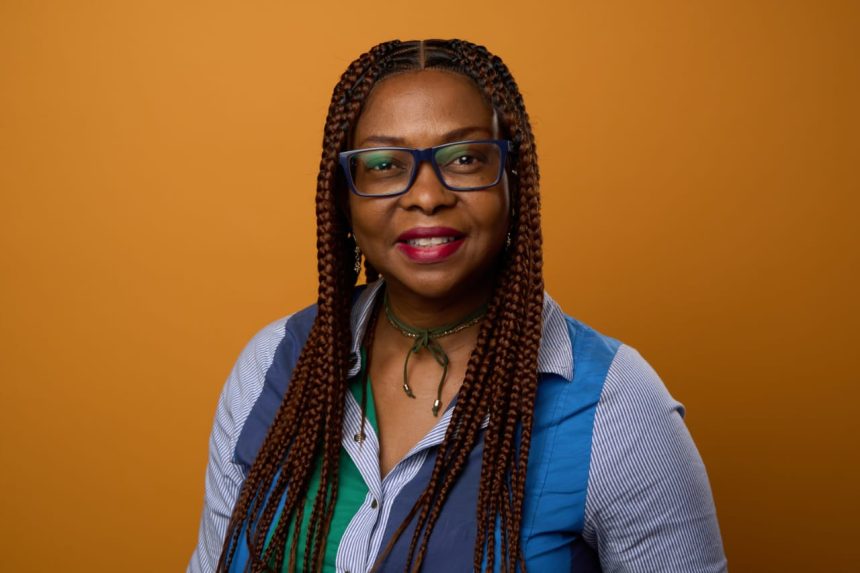
Sociologist and Regional Director for West Africa at The Ford Foundation, Dr. ChiChi Aniagolu, has noted that the solution to Africa’s development crisis may lie in how the continent channels its deepest social bonds.
“Africa’s social and cultural identities must be harnessed as catalysts for progress rather than division.”
Dr. Aniagolu was speaking on Thursday during the Think Tank for Sustainable Development (TTTSD) webinar titled “Reinventing Tribalism to Work for Africa’s Development.”
The session marked the second instalment of TTTSD’s dialogue series, which the non-partisan network says promotes “informed policy dialogue, national cohesion, justice, good governance, and sustainable development across the continent.”
The webinar drew participants from government, civil society, and academia.
Addressing the cross-sector audience, Dr. Aniagolu challenged Africa’s dominant intellectual camps, those who defend tribal allegiance as identity and those who demand its eradication for modern nationhood, and proposed a third path: re-engineering the emotional and psychological structures Africans already trust to drive measurable development.
“As Nigeria and many African nations confront complex socio-economic challenges, the role of citizens, institutions, and communities in shaping a more equitable future cannot be overstated,” she said.
She stated that “Nothing generates more intense conversation or raw passion among Africans than the subject of the tribe”.
“Almost every systemic challenge that Africa faces today is ultimately linked back to tribalism. But the common perception of tribalism as a purely destructive, regressive force is an incomplete narrative. The foundational core of tribalism is not hatred for the outsider, but an innate, evolutionary devotion to one’s own community.”
Dr. Aniagolu drew a sharp distinction between authentic tribalism and its political distortions, clarifying that what Nigerians commonly label as tribalism is often mischaracterised.
She cited that appointing only people from one’s ethnic group into positions of power is not tribalism, it is cronyism because those who get the positions are not necessarily the best from the tribe but friends and associates of the appointer.
Again, taking all projects to your village or LGA is not tribalism because many of those projects end up not being viable and not useful to the tribe. Nigeria is littered with such abandoned projects.
Also, voting for someone from your tribe regardless of capacity is not tribalism, but sentimentalism, because ultimately, an incompetent person does not benefit the tribe.
Instead, she defined tribalism as “the state of organising into groups based on shared cultural, ancestral, or ideological identity,” and argued that reinventing it requires a “fundamental shift in its vector of energy.”
“Instead of directing its focus outward in a posture of defence or aggression against neighbouring communities, the redefined tribe turns its gaze inward, focusing entirely on its own internal capacity, welfare, and structural development,” she said.
“Pride becomes directly tethered to tangible, measurable metrics of human and structural development within the community itself.”
Tracing the origins of destructive ethnic rivalry, Dr. Aniagolu cited scholars Mahmood Mamdani and Archie Mafeje to argue that “the hyper-adversarial manifestation of tribalism on the continent is not an ancient, inherent African flaw.”
She noted that pre-colonial Africa was marked by “fluid, porous boundaries, intermarriage, and flexible trade networks.”
Colonialism dismantled that fluidity through four mechanisms: arbitrary borders, hierarchical favouritism, codification of identity, and skewed resource distribution.
For instance, she explained that colonial infrastructure in Nigeria favored southern coasts and cocoa belts, leaving the north “educationally and structurally isolated,” triggering “a zero-sum struggle for state power” at independence.
“This is the cycle we are still trapped in,” Dr. Aniagolu warned.
“In the post-colonial era, ethnic identity has been weaponised by political elites competing for centralised state resources… This transforms democratic elections into ethnic censuses, where policy debates are sidelined by identity politics.”
To break the cycle, Dr. Aniagolu urged Africa to “dismantle the imperial executive power, build inclusive civic identities, and create equitable governance systems.”
Pointing to indigenous models that already demonstrate success, she said, “Post-independence African leaders did not suppress identities to build states; they leveraged communal ethics. In Tanzania, it was Ujamaa, familyhood. In Kenya, it was Harambee, ‘let us pull together.’ Communities deployed these philosophies to crowd-fund clinics, schools, and roads, without waiting for a single dime from the central treasury.”
She cited Nigeria’s own examples, including the Igbo tradition of “Igba-Boi” apprenticeship system and town unions, which build markets, fund scholarships, and lay roads through pure self-reliance.”
For the Yoruba, “The Omoluabi philosophy emphasises character, community responsibility, and pooling resources to establish schools.”
She argued that “the Northern tradition of Amana and community-led farming cooperatives drives agricultural and educational development.”
“When ethnic identity is channelled inward, it ceases to be a tool for division. It becomes a direct catalyst for development,” she said.
“Imagine a nation where communities compete on innovation, on literacy, and on infrastructure. This turns friction into collaborative growth.”
Insisting that forced nationalism would always fail, Dr. Aniagolu rejected calls to erase tribal identity in favour of nationalism, arguing that “attempting to completely erase tribal or ethnic identities often backfires.”
Citing historical failures, Dr Aniagolu noted that in Zaire, Mobutu’s Authenticité campaign “marginalised hundreds of ethnic groups and left a fragmented state that collapsed into deep regional conflicts.”
In Ethiopia, forced “Amharization” fueled “bitter regional rebellions,” in Cameroon, attempts to absorb British systems into a French model sparked the “ongoing Anglophone Crisis” that “cost the economy billions.”
Also in Nigeria, post-Biafran war pressure left many Igbo “psychologically compelled to renounce their heritage… leaving a lasting legacy of structural trauma.”
The sociologist warned that “when a state acts as an existential threat intent on erasing local identity, it completely breaks the psychological contract between the citizen and the state.”
According to her, “true national cohesion is built by creating a shared civic identity where every group feels secure, represented, and valued.”
Dr. Aniagolu closed by framing reinvented tribalism as “a direct, decolonial counter-narrative to toxic, state-enabled structures of negative tribalism.”
“Reinventing tribalism means replacing ‘us versus them’ hostility with a profound love for one’s own people,” she said. “Loving your tribe should not mean demanding unearned privileges at the expense of others. Loving your tribe should mean refusing to let your homeland stay in darkness. It means building hospitals, training youth, and preserving your heritage through tangible, real-world investments.”
“The path forward for Africa does not require choosing between ancestral heritage and modern advancement; the true genius of African development lies in synthesis. Cultural structures must be treated as assets to be deployed rather than liabilities to be managed.”